
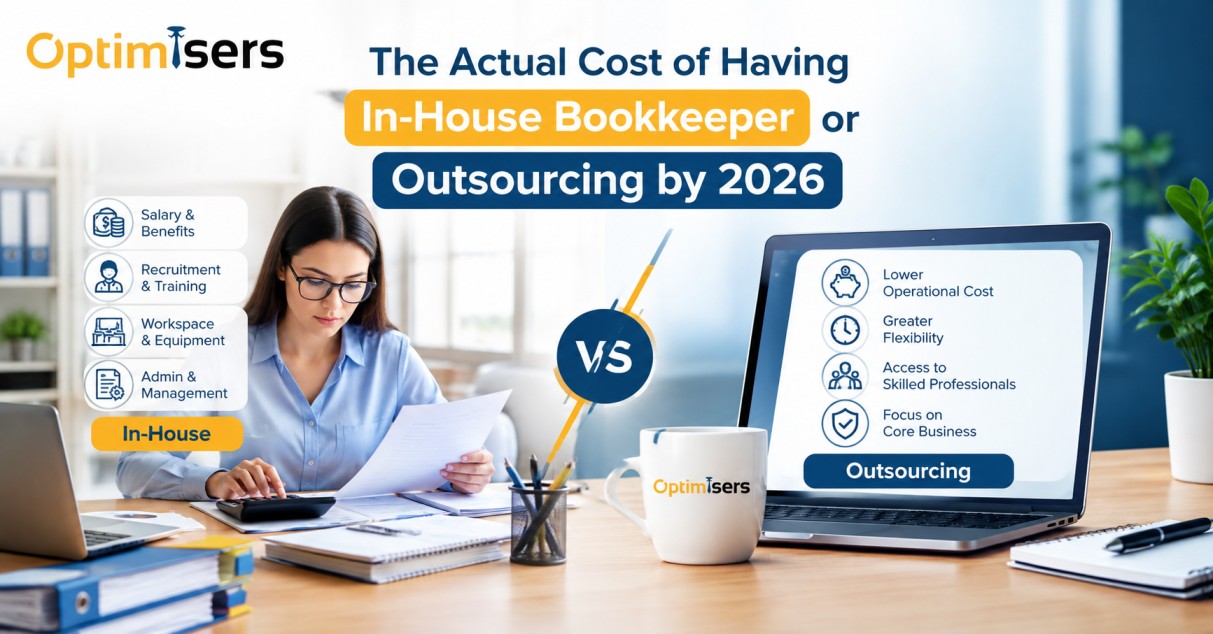
In Australia, various accounting agencies and businesses realize the significance of bookkeeping in ensuring that appropriate accounting records are kept. However, the decision on whether to retain in-house bookkeepers or outsource bookkeeping services might be significant for influencing the total costs of running operations.
By 2026, businesses would have broadened the areas considered in making decisions between retaining in-house bookkeepers and outsourcing. Some of the considerations might include the cost of hiring, payment packages, training, supervision, efficiency of workflow and many more when determining the cost of retaining an in-house bookkeeper.
However, outsourcing bookkeeping services would provide businesses with the opportunity of availing professional services without retaining any employees in house.
What is the Cost of Having a Bookkeeper Working for you Internally?
While the wage of a bookkeeper is one of the factors included in the cost of employing an internal employee, there are many others which also contribute to this cost. Some of the costs include the costs of having an employee on a full-time basis.
They include:
- Wages and superannuation
- Onboarding and recruitment costs
- Leave payment
- Costs of employees
- Accounting software
- Computers and office equipment
- Training and development costs
- Payroll and administrative costs
- Management and supervision
In cases where the internal employee has taken time off due to annual leave or any other reason, the responsibility of this person's work may fall on someone else. This can affect productivity and create stress in the accounting/finance department.
The total cost is therefore much more than the advertised salary.
Hidden Costs of In-House Bookkeeping
When it comes to bookkeeping in-house, one of the problems is the difficulty in measuring certain costs.
Finding a qualified bookkeeper might require some time because companies will have to go through the hiring procedure. This includes advertising the position, reviewing applications, conducting interviews, and making sure that the person really has experience.
Moreover, it might also take into account such cost as that of employee turnover. If the bookkeeper quits, then the company would have to hire another one and train him or her again.
Another issue might be related to workload. There might be cases when the bookkeeper works full-time but not necessarily has a lot of things to do at the end of each month.
Therefore, it might also be necessary to consider workforce flexibility.
What is Outsourced Bookkeeping?
Outsourced bookkeeping means working with an external accounting or bookkeeping service that handles all financial bookkeeping tasks as per the agreement between the service and the business or accounting firm.
Some of the tasks that can be done as part of the outsourcing of bookkeeping include:
- Bookkeeping entries
- Reconciling bank and accounts
- Handling payables and receivables
- Handling payroll bookkeeping
- Entering financial information
- Accounting record management
- Monthly bookkeeping
- Management reporting
- Year-end bookkeeping
Rather than having an internal person for bookkeeping, businesses get access to professionals in the field.
Cost Efficiency from Outsourcing Bookkeeping Services
Cost efficiency forms one of the main motivations for outsourcing bookkeeping services.
Outsourcing makes it unnecessary to offer the same employee benefits, work environment, facilities, and other related recruitment expenses that would be offered to an internal full-time employee.
Rather, the company pays for the needed bookkeeping services as per the agreement.
This may be especially helpful for small companies that have a need for professional bookkeeping assistance but lack the need for full-time bookkeepers.
In the case of accountancy firms, outsourcing provides additional flexibility without the immediate hiring of extra employees.
Outsourcing Helps Capacity
Cost is not the only element that must be considered.
In the case of Australian accounting firms, bookkeeping capacity may rise considerably during periods of high activity. There could be increased activity from client onboarding, BAS, year-end activities, tax obligations, and many other accounting obligations.
Additional capacity can be achieved through an outsourced bookkeeping service.
This allows accountants and managers within the organization to concentrate on their core activities like advice and development, while the bookkeeping process can be done using the assistance of an outsourced firm.
Software and Technology Costs
Bookkeeping in modern times does not only involve data entry. Business organizations need many tools and systems including accounting platforms, cloud services, automation systems, reporting and more.
The maintenance of all these systems may be costly when doing everything internally.
An outsourcing company may have processes and technology in place for doing the bookkeeping work.
Scalability Is Another Significant Factor
The needs of a business can alter rapidly.
While a business could have a light bookkeeping load in one period, it could have increased transaction volumes at another time. Hiring a person on a full-time basis does not always offer the required adaptability.
With outsourcing, the firm can adjust the volume of services based on its needs.
In the case of an accounting firm, it can prove beneficial for the firm when it takes up new clients. Rather than hiring additional personnel, the firm can rely on bookkeeping support from outsources.
Quality and Accuracy Are Essential
The least expensive bookkeeping service would turn out to be a costlier choice in terms of cost savings if it leads to mistakes, discrepancies in reconciliations, lack of records, or any further corrections.
Accurate bookkeeping serves as the foundation for accurate financial reports and tax filings.
Outsourcing bookkeepers can create processes for transactions recording, reconciling, reviewing, and reporting. This could assist businesses in maintaining more precise financial records.
It depends on the selection of an appropriate outsourcing vendor who has accounting experience, quality controls, secure processes, and knowledge about Australian requirements.
In-House vs. Outsourcing Bookkeeping Services in 2026
It all depends on the size, workload, budget, competences, and future plans of the business.
An in-house bookkeeper is handy for the business that needs one permanent employee to work with their internal team every day. However, the total cost of employment may significantly exceed the basic salary of the employee.
Outsourcing allows to have bookkeeping skills and save on recruiting, paying salaries, setting up workplaces, etc.
For flexible businesses and accounting firms in need of expanding their capacities, outsourcing is a viable way of operations.
How Optimisers KPO Helps with Outsourcing Bookkeeping
Optimisers KPO offers professional accounting and bookkeeping services tailored specifically for businesses and accounting firms from Australia.
Our bookkeeping outsourcing service allows accounting firms to deal with routine accounting workloads and follow structured processes and financial record keeping.
Using the service of bookkeepers, accounting firms will be able to benefit from additional operational assistance without forming their own internal team.
Base Your Decision On Cost, Not Salary
When choosing between the internal bookkeeper and outsourcing in 2026, basing your decision on salary alone may prove to be inadequate.
Costs associated with hiring an internal bookkeeper may include recruitment, superannuation, annual leave, software, equipment, training, management hours, overheads, and staff turnover.
Outsourcing transforms cost structure by providing access to bookkeeping services without needing as many resources internally.
As companies and accountants evaluate their options, the proper way is to consider the total cost involved, flexibility, work load, quality expectations and business objectives.
Bookkeeping can turn out to be a more flexible process when outsourced properly.